
Today the summer solstice arrives over Querétaro, the longest day of the year. The sun reaches its highest point before the turning begins, and most of us greet the day as pure abundance, which it is. What interests me is the turning folded inside the fullness, and what it has to teach us about how to live.
What Bernal knows about the turning of the sun
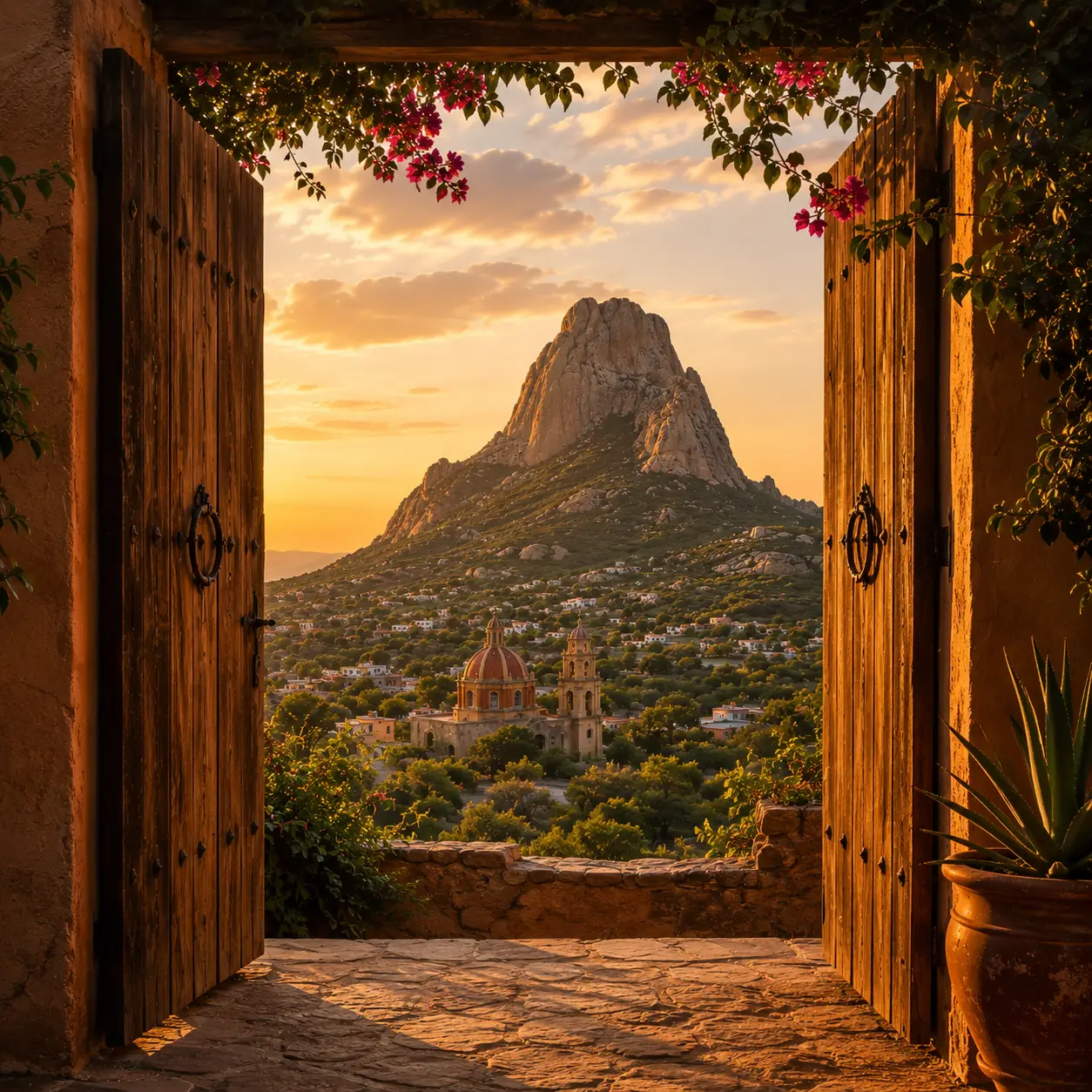
An hour from my door, people have marked these turnings for generations. Each spring, thousands travel to the Peña de Bernal, the volcanic monolith that rises some three hundred meters above the valley, sacred to the Otomí-Chichimeca long before the Spanish arrived. Dressed in white, they climb partway up the rock to greet the equinox, honor the four directions, and light a new fire, carrying offerings toward the cross at the summit. The ceremonies center on the balance of light and dark, and the people gather them into one prayer for peace and harmony across the world.
Depth psychology gives this a name. Jung described a movement he called enantiodromia, the way any extreme begins, in its very fullness, to lean toward its opposite. The summer solstice teaches the same law in its most generous form, since the greatest light already carries the return of darkness within it. Fullness and turning live in the same hour, and the season asks us to hold both.
Welcome at the threshold
This year the hinge of the season meets a smaller, more human turning. A few weeks ago, with the World Cup arriving and Iran’s national team caught between a war and a tangle of visas, México offered to host them, and the border city of Tijuana opened its arms. Neighbors gathered at the fence outside the team hotel, some of them in tears, greeting players their own government had been instructed to treat as the enemy. The city took the team in as one more home side to cheer. In a season built for suspicion, a community chose hospitality.
Hospitality has always lived at thresholds. The ancient Greeks called it xenia and met the stranger at the door as someone who might carry the divine in disguise, which made welcome a sacred trust. Campbell traced the same pattern through the hero’s journey, where the traveler who crosses into unknown country survives by the kindness of helpers met along the road. Depth psychology widens the circle further. The figure at the threshold often carries the very part of ourselves we have sent into exile, so that the welcome we extend outward tends to mirror the welcome we have already made room for within.
Here the two turnings meet. The solstice gives its fullest light on the very day it begins to give that light away. Generosity is at its truest at the peak, in the hour when we hold the most and could most easily close our hands around it. Tijuana stood at exactly that kind of peak, a city handed every reason to close the gate, and it answered the season’s logic instead.
Most of us will pass this solstice far from any border crossing, in the ordinary rooms where our own thresholds sit. This Sunday many of us also keep Día del Padre, a day that holds its own arrivals, the fathers present at the table and the ones we carry in memory. The invitation of the longest day reaches every one of these rooms. We might notice where we have cast someone as the stranger, inside the family or across a border, and ask what it would take to widen that doorway by even a little.
In revising A Life Aligned this year, I kept returning to the idea that belonging arrives less from where we begin and more from where we are received as we are. Welcome belongs to that same practice, the daily work of meeting what arrives with an open hand.
So I will leave you at your own threshold this week, with a simple question. Where does a door in your life stand ready to open a little wider, and what keeps your hand on the latch? You might honor the summer solstice by choosing one welcome you have postponed, a message sent, a name spoken again, a chair drawn up to the table, and offering it while the light is still full.
With care,
Mark
Writing from home in Querétaro