

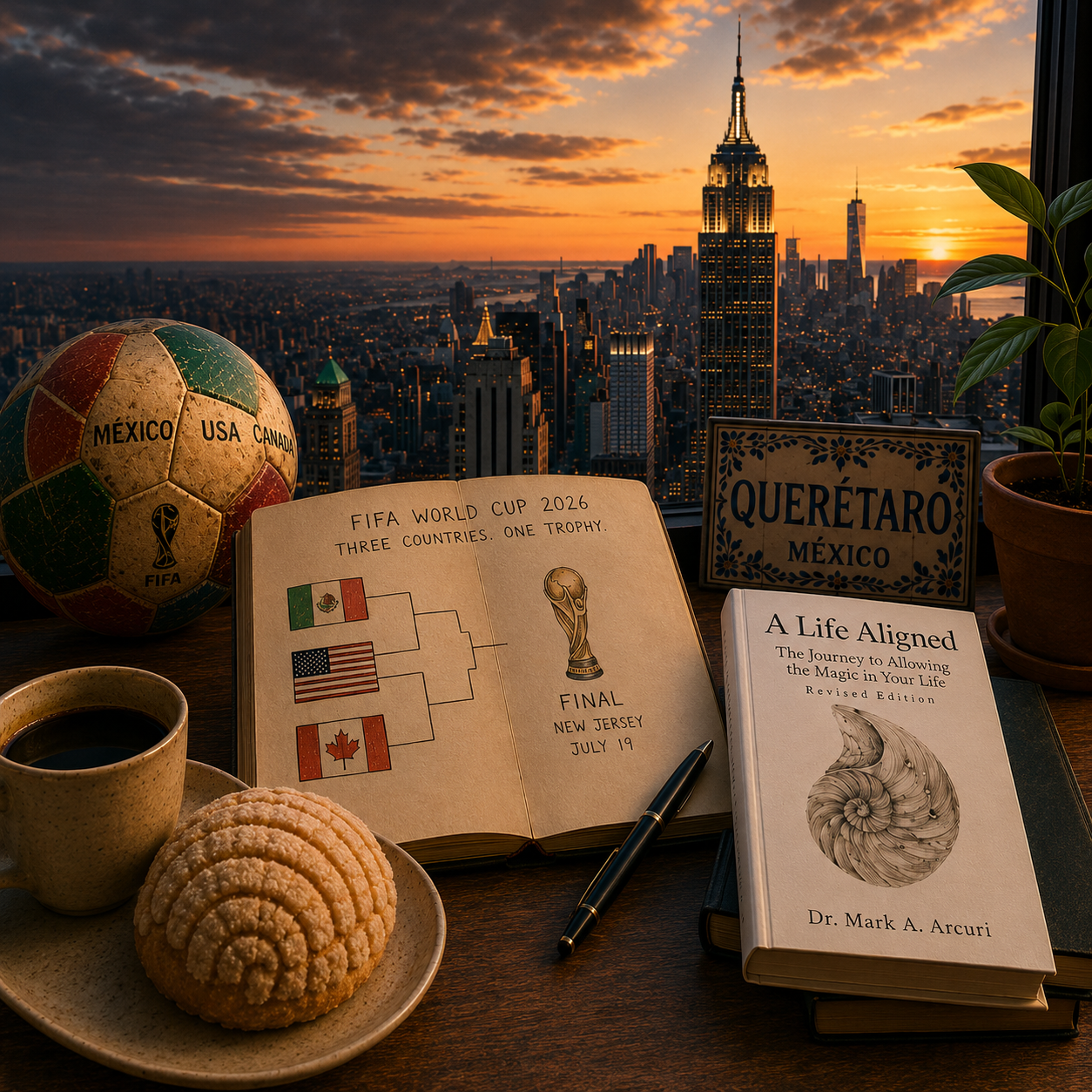
I am writing from Long Island, back in the place that raised me, here for two weeks in the middle of summer while the World Cup moves into its knockout rounds across three countries at once. México plays tonight, and I feel my attention travel south even as I sit in New York. A return like this raises an old question in a new way, the question of where home is once you have built a life somewhere else. I came north for a short visit, and the trip keeps answering that question for me with a clarity I did not expect to find.
Joseph Campbell described the last movement of the hero’s journey as the return, the crossing back into the world you came from while carrying something you found in the far country. He wrote less about how that first world looks once you yourself have changed. The United States formed me and gave me my first language, and I still walk through it now as a kind of guest. The streets are familiar, and I am no longer quite shaped to fit them, and that small misalignment turns out to be the whole lesson.
How a return reveals where home is
I relocated to Querétaro at the end of 2024, and the move was a turn toward something rather than a flight from anything. I wanted a slower rhythm and a life built around depth and creative work, days that begin with espresso and pan dulce and the long light of central México. Coming back has confirmed the choosing. I feel real affection for the people here and the pleasure of a familiar return, and at the same time I feel, with a steadiness that surprises me, that my home now sits two thousand miles to the south.
James Hollis writes that the second half of life asks a different question than the first. The early decades press us to meet inherited expectations, the roles handed down by family and culture and circumstance. Later the question turns inward and grows more honest, asking what is actually ours to live and where we can be most fully ourselves. Read this way, where home is becomes a matter of alignment more than geography, the place where the outer life and the inner life stop arguing with each other. For me that alignment found its address in Querétaro.
When you finally know where home is
There is a Jungian thread here as well. Individuation, the long work of becoming who you actually are, often asks you to leave the collective identity you were handed, the inherited sense of belonging that arrives before you ever choose it. To return to your origin and find that it no longer contains you is one sign that the work has moved. This is where the tournament becomes more than a backdrop. Right now my two countries stand on the same fields and chase the same trophy across the same continent, and I can sit in a room in New York and feel my heart travel to the Azteca.
Most people keep the same address their whole lives, and this threshold still finds them. You can walk back into an old neighborhood, an old role at work, an old version of a relationship, and sense that you have grown past the shape of it. That sensing can feel like loss, and it also stands as evidence of development. The place stayed itself while you became someone larger, and the friction between the two carries good information. The practice is to let a return teach you, to read the experience of an old fit as a measure of how far you have come.
This is much of what I explore in A Life Aligned, the slow work of bringing an outer life into agreement with an inner one and the courage that asks of us at each threshold. If the idea of return as a measure of growth speaks to you, the book follows that arc in greater depth.
Tonight I will follow México from here in New York, and I will feel at home inside that small contradiction. The final comes to a field near the country I came from in the middle of July, and by then I will already be back in Querétaro. Both places can hold me, and one of them is home. Where in your own life have you returned to something familiar and noticed how much you have grown? Let that question travel with you this week, and let it show you where home is for you now.
With care,
Mark
Writing from Long Island