

When I moved to Querétaro I learned ahorita before I understood most of the grammar around it. What does ahorita mean? The word looks like a diminutive of ahora, now, so a newcomer assumes it means something close to right this second. Anyone who has lived here for a while will tell you otherwise. Understanding what the word actually does turned out to be one of the more useful things I have learned about time, and about the difference between waiting and patience.
What does ahorita mean?
In practice ahorita covers a generous range. It can mean in five minutes, later today, sometime this week, or a courteous version of probably never. The Real Academia Española records it as a diminutive of ahora used across much of Latin America, and notes that in Puerto Rico and the Dominican Republic the two words separate cleanly, with ahorita settling into in a little while. Standard translations give right now or in a moment, and that misses almost everything. People arriving from the United States tend to find this maddening for the first year or so, because it sounds like a commitment and behaves like a weather forecast. What I have come to appreciate is that the word is being honest about something most of our language hides, which is that timing usually belongs to circumstances rather than to the person speaking.
The version that has nothing to do with Spanish
Anyone who has built something inside an organization knows a form of this already. You make the case carefully, in writing, with evidence, on the timeline the situation actually calls for. Then it enters a queue somewhere and the calendar keeps turning. Nothing is refused and nothing is approved either, and support agreed to in principle arrives in a form that would have been useful several months earlier. This belongs to the ordinary friction of doing meaningful work inside a structure larger than yourself.
The fatigue this produces gets misidentified. Delay is a fact of institutional life and most of us make our peace with it early. What wears on a person is the mismatch between their own investment and the system's metabolism, and the message that mismatch appears to carry: that you cared more than the situation called for, that your judgment about what matters sits out of step with the people holding the decisions. Jung described projection as the psyche placing something of its own outside itself and then experiencing it as arriving from out there. An institution can tell you what your work is worth only once you have handed it the instrument for making that assessment.
Waiting and patience are different things
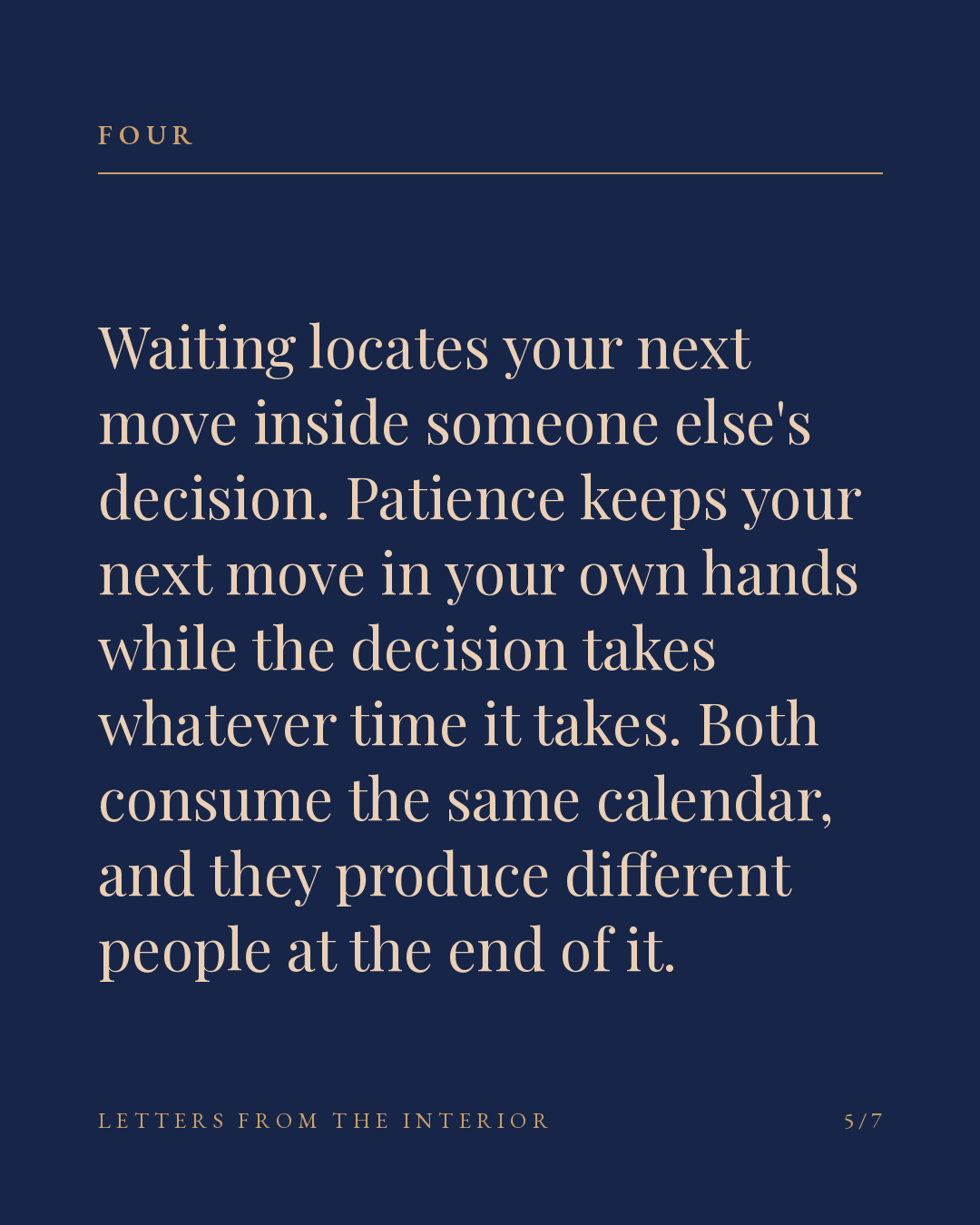
Waiting and patience look identical from outside, and they differ in a way that matters. Waiting locates your next move inside someone else's decision, so the months pass and you arrive at the far end holding whatever that decision turns out to be and very little else. Patience keeps your next move in your own hands while the decision takes whatever time it takes. Both consume the same calendar, and they produce different people at the end of it.
What patience looks like in practice
In practice this looks ordinary. You keep making the case through the proper channels, in writing, with evidence, on a schedule you set rather than one you absorb. And you put real energy into the work whose return depends on no one's signature: the students in front of you, the people you serve, the writing, the things you build and own outright. The first keeps your integrity with the institution intact, which matters, because leaving a commitment badly costs more than it saves. The second keeps your own development free of a timeline you have no hand in.
Ahorita makes no promises, and there is a strange freedom in that. The word declines to pretend that the speaker controls the timing, which leaves everyone free to get on with the parts they do control. If you are standing somewhere in that position right now, here is a question to carry into the week. Where are you waiting on a decision that has become a substitute for your own next move? And if the answer never arrives at all, what would you do between now and Friday?
With care,
Mark
Writing from home in Querétaro
A Life Aligned is available in paperback, eBook, and audiobook from Amazon, Apple Books, Barnes & Noble, Kobo, and other retailers. You can find all formats at drmarkarcuri.com/a-life-aligned.
Dr. Mark A. Arcuri is an integrative coach, author, speaker, and psychology professional based in Querétaro, México.