

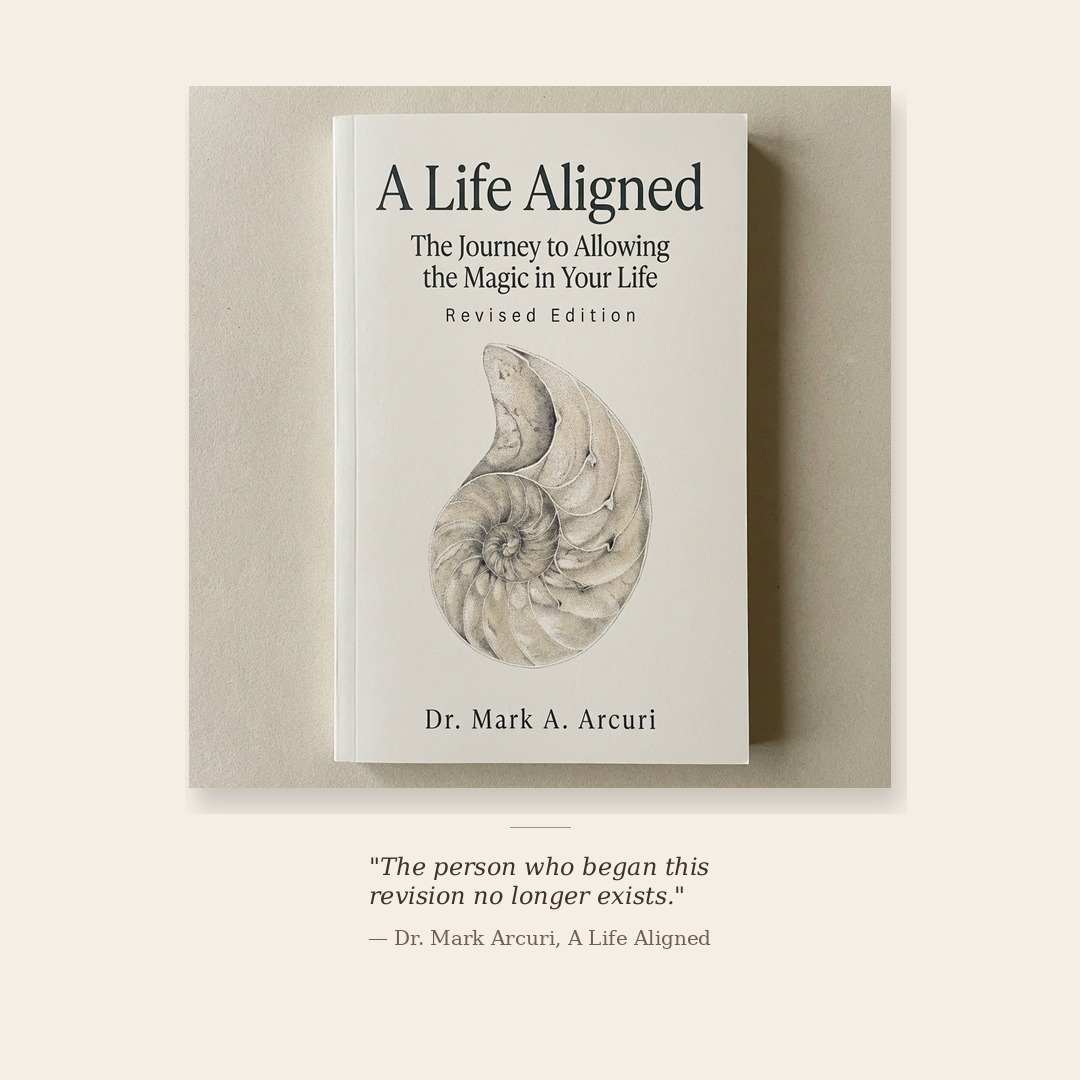
A few days ago, the revised edition of A Life Aligned: The Journey to Allowing the Magic in Your Life went live. I held the paperback in my hands, turned it over, and felt something I did not expect. Something closer to the quiet that follows a long storm, when you step outside and realize the landscape has changed and so have you. A stillness that carries weight. The kind that asks you to stand still for a moment before you start walking again.
People have asked what it was like to revise a book I first wrote nearly twenty years ago. I want to answer that honestly, because the truth of revising A Life Aligned is more tangled and more human than I anticipated.
The Crucible of Revising A Life Aligned
I thought I was updating a manuscript. Refreshing the language, adding what I had learned, bringing the framework into conversation with the life I am living now in Querétaro. That is what I told myself at the start. What actually happened was something else entirely. The revision became a crucible. It asked me to sit inside my own earlier words and reckon with the distance between the person who wrote them and the person reading them back.
Some passages still rang true. Others made me wince, and the wince came from recognizing a certainty I no longer possess. The original edition had the confidence of someone who believed alignment was something you could arrive at and stay. Twenty years of living taught me that growth keeps moving, that the spiral keeps turning, and that the most honest thing I could do was let the book reflect that ongoing motion rather than a finished destination.
There were days when the work felt laborious in every sense. I found myself confronting fears and anxieties I thought I had already resolved, only to discover they had simply changed shape. Old grief surfaced. Questions I had set aside years ago returned with new weight. At times it felt like being tossed into shadowy depths, stripped of the familiar distractions that had kept certain truths at a comfortable distance.
Frida Kahlo's words became a kind of anchor during those stretches of revising A Life Aligned: La verdadera fuerza se forja en los momentos más oscuros; es justo ahí donde descubres tu capacidad para aguantar y volver a nacer. True strength is forged in the darkest moments; it is there that you discover your capacity to endure and be reborn.
Sitting in the Dark
There is a moment in the final chapter where I describe the power going out while I was writing. The familiar world slipped into silence, and I was left alone with my thoughts and the dark. I remember sitting there, held in place, the work both impossible to advance and impossible to abandon. Life itself seemed to be insisting that I stop performing progress and simply inhabit the space between who I had been and who I was becoming.
I had written about this space for years. I called it the neutral zone. But inhabiting it, truly inhabiting it, with no way to edit my way out, was its own kind of reckoning.
That evening carried the texture of the entire process. Revising A Life Aligned kept placing me at thresholds I could only cross by letting go of something I had been holding. Old certainties about what the book should say. Old identities attached to the person who first wrote it. Old habits of explaining rather than simply telling the truth. Each time I let something fall away, the writing moved forward. Each time I tried to hold on, it stalled.
The People Who Held It
The revision had witnesses, and they mattered. Carlos held steady through the entire process, his belief in me arriving, as it often does, before my own. My editor, Sonia Castleberry, brought a kind of care I can only describe as presence, honoring my voice while helping the work become clearer, more spacious, and more itself. My friend Uriel Ramírez, whose art graces the cover, reflected something back to me through his perception as an artist that I could not have seen on my own. Those long conversations with Uriel were among the most generative parts of the process. They were how I found my way back to the heart of the work when I had wandered from it.
I mention them because the myth of the solitary author has never matched my experience. A book like this one takes shape in relationship. It is shaped by the people who hold space around it, who ask the right questions at the right moments, who trust your timing even when you are doubting it yourself. Their presence lives between the lines of these pages.
The Shift That Mattered Most
One of the changes that carried the most weight was renaming the final step of the 5-Point Process. In the original edition, that chapter was called "Living a Life Aligned," as if alignment were a destination you could reach and hold. This time, I called it "Integration." The shift was small on the page and significant in what it meant. Integration asks you to gather every part of yourself, old and new, shadow and light, and keep weaving them into something whole. It is a continuing practice, a spiral that deepens with each return. That felt truer to the life I am actually living than any promise of arrival ever could.
What surprised me most was the realization that the person who began this revision no longer exists. That sentence appears in the book's closing chapter, and I meant it literally. The revision changed me. It asked me to let go of old certainties, to make peace with the spiral rather than trying to master it, and to allow a voice I did not fully recognize to come forward on the page. The book I finished is profoundly different from the one I started, and yet it feels truer to the spirit of the original than the original ever could.
Your Own Revision
I share this because I suspect the experience is familiar, even if yours has taken a different form. We all carry earlier versions of our story. Words we once used to describe ourselves that no longer fit. Frameworks that served us well until they didn't. Identities we outgrew so quietly we barely noticed until we tried to put them on again. There comes a point where revising becomes necessary, where the old language stops holding the life you are actually living, and something in you knows it is time.
That revision might be a conversation you have been putting off, a belief you are ready to set down, a relationship that needs a new shape, or a dream you are finally willing to name out loud. Whatever form it takes, the process will likely ask more of you than you expected. It will take you into uncomfortable places. And on the other side, you may find that you have become someone new, someone who was waiting beneath the surface all along.
What Is Opening Now
I am already discovering this again. As I begin work on my next book, Paradise (re)Discovered, something is shifting that the revision of A Life Aligned made possible but could not yet contain. What is deepening for me now is the recognition that authenticity is the doorway into a more radical belonging, rather than the end of the journey. A Life Aligned reclaimed the self. What I am exploring now is what happens when that reclaimed self opens into something larger, when the work becomes a lived participation in a world where the boundaries between self and other begin to soften.
I am inside that process, which means I cannot yet see its full shape. But I trust the spiral. Revising A Life Aligned taught me that much. It has always brought me back, each time with a bit more wisdom, a bit less fear, and a deeper readiness to welcome myself home.
The revised edition of A Life Aligned is available now in paperback at Amazon and wherever books are sold online, with the e-book arriving in about two weeks and the audiobook shortly after. If you choose to read it, I hope you will feel what I felt in the writing: that this is a book about staying faithful to the questions, and that the most important alignment is the one you return to, again and again, whenever you have drifted.
With care,
Mark
Writing from home in Querétaro